
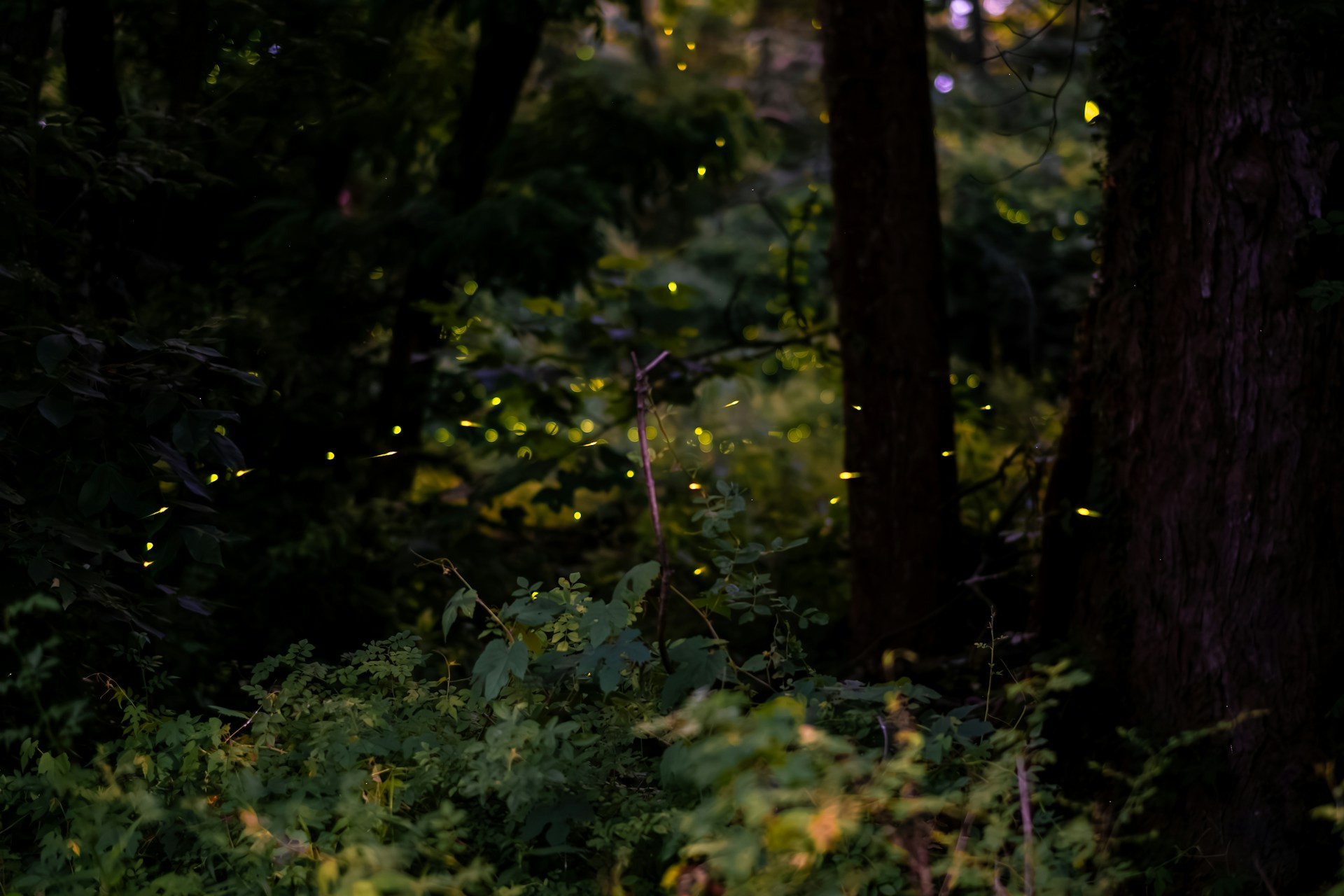
Sometime in late spring, on an evening when the air is warm and still, the first lightning bugs rise from the grass. By June in Middle Georgia, yards, fields and woodland edges can be full of them, blinking on and off in the dusk. Whether you grew up calling them lightning bugs or fireflies, watching them is one of the simplest and most calming things a summer evening has to offer.
Beetles that make their own light
Despite the name, fireflies are not flies. They are beetles, part of a family with many species around the world. Their glow comes from special light organs in the abdomen, where a chemical called luciferin reacts with oxygen with the help of an enzyme called luciferase. The reaction gives off very little heat, which is why firefly light is often called cold light.
Fireflies glow even before they can fly. Their larvae, sometimes called glowworms, live on the ground in leaf litter and damp soil, where they feed on snails, slugs and worms. Many species spend a year or more as larvae before emerging as adults for just a few weeks of summer.
A language of flashes
The blinking is a conversation. In many species, males fly and flash a pattern particular to their kind, and females waiting in the grass or in low plants answer with a flash of their own. Some patterns are quick single blinks, some are long glows and some are a series of rapid flashes. With a little patience, you may notice different patterns in different parts of the yard or at different times of the evening.
There is drama, too. Females of some firefly species imitate the signals of other species to lure in males, which they then eat. Even the gentlest summer scene has its secrets.
In the Great Smoky Mountains, one species is famous for flashing in near unison, and viewing is managed by the park each year. Details are on nps.gov if you are curious.
A firefly evening, step by step
- Go outside about twenty to thirty minutes after sunset, when activity often picks up.
- Turn off porch and yard lights so your eyes can adjust and the fireflies can see each other’s signals.
- Settle into a chair or onto a blanket and let your eyes relax. Adjusting to darkness takes a while, so be patient.
- Watch one area of the yard. Notice the rhythm of the flashes, their color, which can range from yellow to green, and how high the fireflies fly.
- If children want to catch a few, use a jar with air holes, keep them for just a short time and let them go the same evening.
Making your yard friendlier to fireflies
Many people say there seem to be fewer fireflies than when they were young, and researchers who study them point to concerns such as habitat loss, pesticide use and light pollution. A few small choices can help in your own yard. Keep outdoor lights off or low at night, since artificial light can drown out the signals fireflies use to find each other. Leave some leaf litter and a patch of taller grass or an unmowed garden edge. Use fewer pesticides, especially on the lawn.
Then, on a warm June night, sit and watch. There is nothing to do and nothing to count unless you want to. It is just you, the dusk and a yard full of tiny lights, saying what fireflies have said to each other every summer for a very long time.