
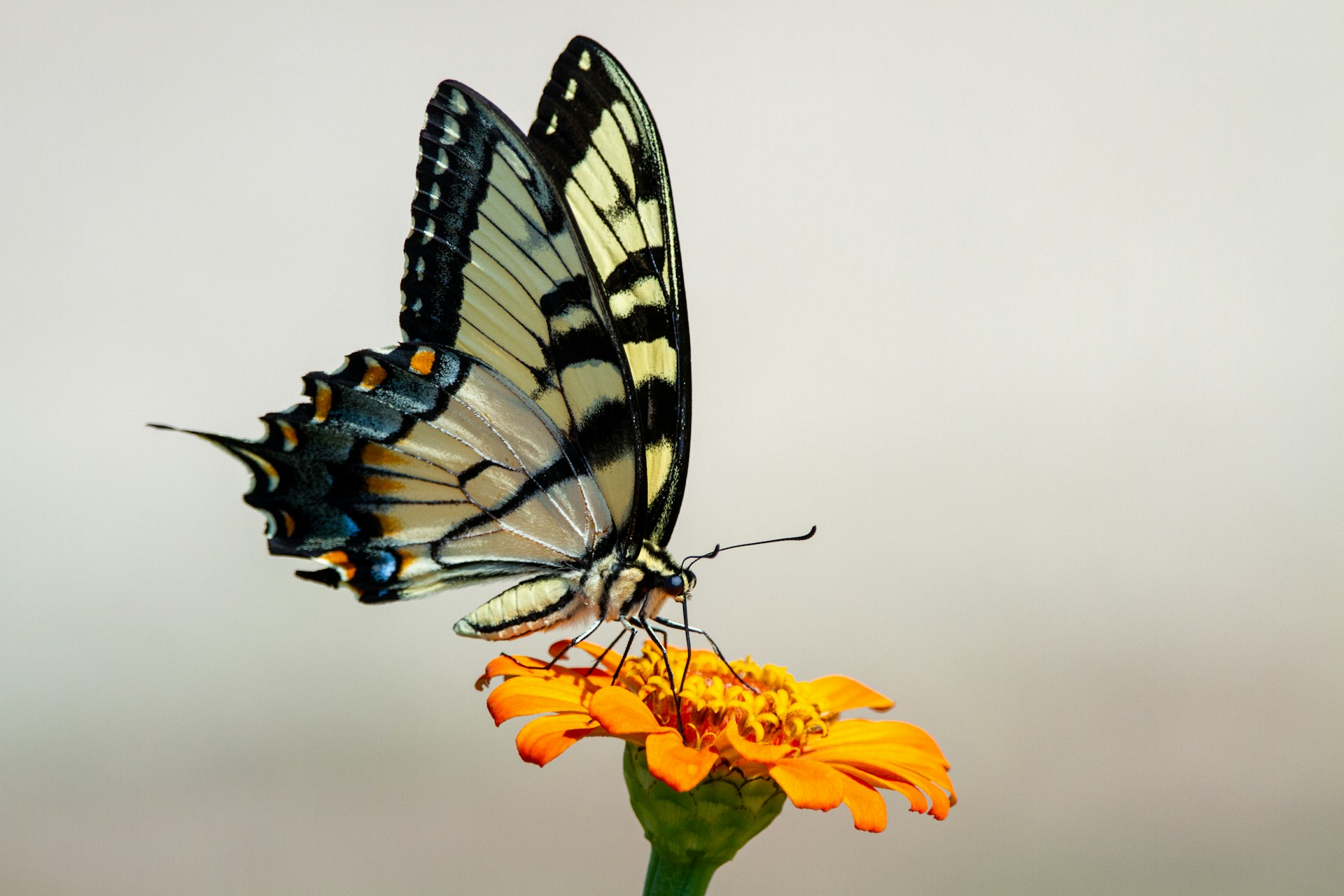
On a sunny June afternoon, a patch of flowers in Middle Georgia can be busy with wings: big yellow-and-black swallowtails gliding from bloom to bloom, small orange skippers darting low, a monarch passing through. Butterfly watching asks very little. You do not need binoculars or a field guide to start, only a sunny spot, some flowers and a few minutes of stillness.
Georgia’s state butterfly
The eastern tiger swallowtail is Georgia’s official state butterfly, and it is one of the most common large butterflies in the Southeast. Males are bright yellow with black tiger stripes. Females can be either yellow or a dark, nearly black form, often with a wash of blue on the hind wings. Their caterpillars feed on the leaves of trees such as tulip poplar and wild cherry, which grow throughout the state.
Host plants and nectar plants
A butterfly-friendly garden needs two kinds of plants. Nectar plants feed adult butterflies. Host plants feed caterpillars, and many butterflies lay their eggs only on particular plants. A few classic pairings:
- Monarchs depend on milkweeds, including the native butterfly weed with its bright orange flowers.
- Black swallowtails lay eggs on parsley, dill and fennel, so plant a little extra to share.
- Gulf fritillaries rely on passionflower, including the native maypop.
For nectar, many butterflies visit coneflowers, black-eyed Susans, zinnias, lantana, salvias, Joe Pye weed and butterfly weed. Plant flowers in clusters rather than one here and one there, so butterflies can find them easily, and choose plants that bloom in turn from spring into fall. Your county office of the University of Georgia Cooperative Extension can suggest native plants suited to your area.
When caterpillars start chewing your parsley, try to see it as a success rather than a problem. That is the garden doing its job.
Small touches that help
Butterflies depend on outside warmth to fly, which is why they are most active on sunny days, often from late morning through afternoon. A few flat stones in a sunny spot give them a place to bask. A shallow dish of damp sand or a muddy patch offers minerals, and on summer days you may see butterflies gathered there in a behavior called puddling. Going easy on pesticides, especially broad-spectrum insecticides, protects caterpillars as well as adults.
June is also when many communities celebrate National Pollinator Week, a yearly reminder of how much our gardens and farms depend on bees, butterflies, moths and other pollinators.
Butterfly watching as a slow practice
Choose a shady seat near your flowers and simply watch. Follow one butterfly as it moves from bloom to bloom. Notice how it lands, how its wings open and close, how long it stays. Try to see its colors in detail: the edging on the wings, the spots, the way the light catches the scales. When it flies away, wait for the next.
It is a lesson in patience and in letting go. You cannot make a butterfly land where you want it to. You can only sit, pay attention and enjoy what arrives. On a hot afternoon, there are few better ways to spend fifteen minutes in the shade.