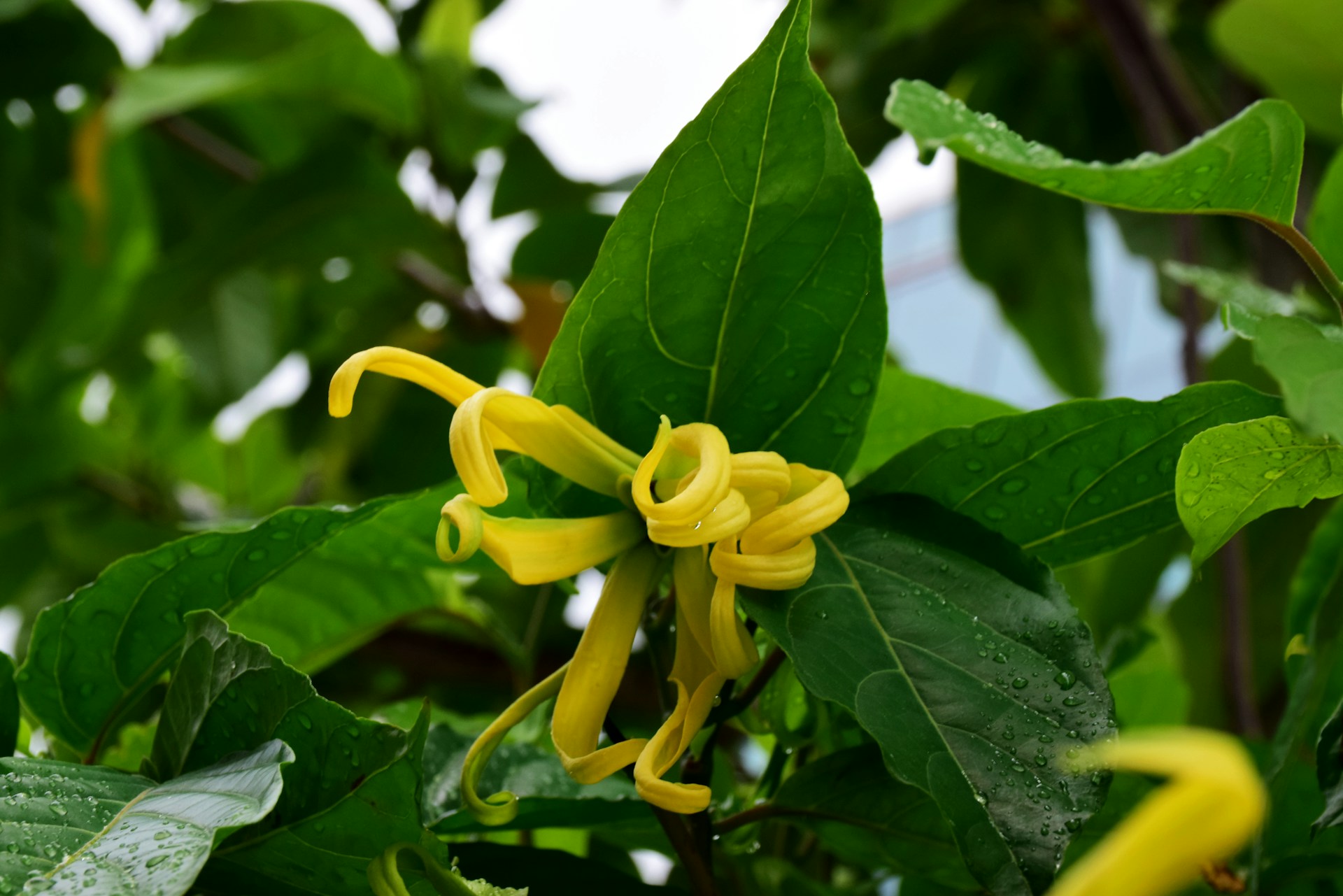
Ylang-ylang is one of those names that sounds like a song, and the flower lives up to it. The scent is intensely sweet, creamy and floral, with a hint of banana and something almost like jasmine, so rich that perfumers often call it narcotic. It comes from a tropical tree whose drooping yellow-green flowers look like a cluster of twisted ribbons, and it has traveled from the islands of Southeast Asia into some of the most famous perfumes ever made.
The Flower of Flowers
The tree, Cananga odorata, is native to the Philippines, Indonesia and surrounding regions. The name ylang-ylang is usually traced to the Tagalog word ilang-ilang, and it is often translated as flower of flowers, though some scholars suggest it refers to the wilderness where the tree grows. The flowers are green when they open and turn a deep yellow as they mature, and they are at their most fragrant when fully yellow. In the Philippines and Indonesia, they have long been strung into garlands, scattered on beds and infused into coconut oil for the hair and skin.
Islands Built on Scent
In the nineteenth century, French colonists began cultivating ylang-ylang for export, and the center of production shifted west to the islands of the Indian Ocean. Today most of the world’s ylang-ylang oil comes from the Comoros, Madagascar and Mayotte, where the trees are pruned low so that the flowers can be picked by hand. Harvesting happens in the early morning, when the scent is strongest, and the flowers are distilled the same day.
Distillation is unusual. The oil is collected in stages over many hours, and each stage is sold as a separate grade. The first fraction, called Extra, is the lightest and most prized for fine perfume. Later fractions are heavier and more woody and are used in soaps and household products. A grade labeled Complete is the whole distillation combined.
A Perfumer’s Favorite
Ylang-ylang became a cornerstone of twentieth-century perfumery. It is widely noted as one of the floral notes in Chanel No. 5, the fragrance launched in 1921 that became perhaps the most famous perfume in the world, and it appears in countless floral and oriental compositions since. Its richness lets it bridge bright top notes and deep base notes, which is why perfumers reach for it so often.
Ylang-Ylang in Aromatherapy
In aromatherapy blends, ylang-ylang is used for its lush, comforting scent. It pairs well with sandalwood, bergamot, lavender and vetiver, and a little goes a very long way. Many people find it overwhelming on its own and lovely in small amounts within a blend. We make no claims about what it does beyond providing a beautiful fragrance. A few practical notes:
- Start with one drop in a diffuser blend and add more only if you want it.
- Dilute well before any skin contact and patch test first, since rich florals can irritate some skin.
- Some people find very strong floral scents give them a headache. If that is you, use it sparingly or skip it.
- Keep it away from children and pets, and never swallow it.
Enjoying It Simply
A single drop of ylang-ylang added to an unscented body oil turns an ordinary evening routine into something that smells like a tropical garden after rain. Blended with a woody oil in a diffuser, it makes a warm, enveloping scent for a slow Sunday. On a humid April evening in Georgia, with the windows open and the gardenia buds not yet ready, it is a pleasant preview of the lush summer scents to come.